
Mining-themed Stories
Mining has been part of Tyndrum’s history for centuries. The old lead workings remain visible on the hillsides, while gold exploration at Cononish brought new jobs, planning applications and newspaper headlines.
The people interviewed remember exploring disused mines, meeting prospectors at the farmhouse door and campaigning for a commercial gold mine. They also discuss the jobs, payments and environmental questions associated with mining, while Rena Baillie recalls visitors who searched for gold in the burns.
The old lead mines
Lead mining brought workers and housing to Tyndrum. The cottages at Clifton and the workings above the village are reminders of an industry that continued intermittently until 1926.
Dick Steven arrived in the glen in 1958, long after the lead mines had closed. He remembers the abandoned workings and describes what remained of earlier mining activity.
-
The lead mines now are all closed, a good while ago. In fact where I was on the east side of the Killin; it was copper mines, well there had been on the actual farm they packed up would have been between the wars, he gold mines never really, it's never really taken off up in Cornish. Well, it has, but it's never really lasted. I think it's just a case there's not a quantity of gold there, you know, to make it justifiable, to make it worthwhile. I think that's the bottom line. As two or three firms tried it, I think it was about 1980 first, when they were opened first. Well, there would be mines there a long, long while before that, but I think it was in 86, 85, 86 I think.
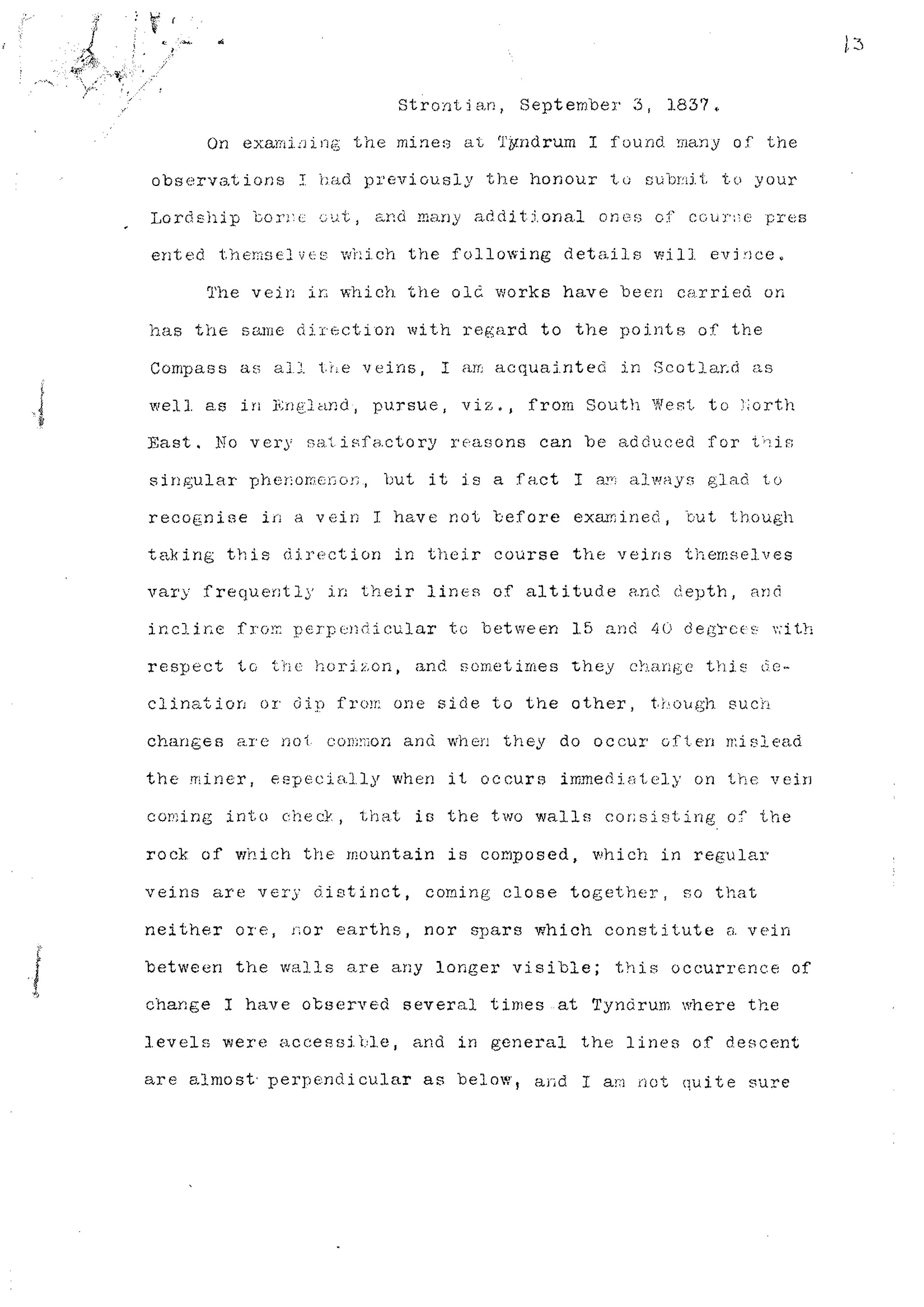
"A fair Royalty for your Lordship's Mines"
In 1837, surveyor J.A. Barron examined the abandoned lead mines at Tyndrum and wrote this detailed report to the Marquis of Breadalbane. He described the vein structure, assessed the ore left behind, calculated costs and potential profit, and outlined what it would take to work the mines again. His observations reveal both the complexity of mining and the economics that drove, or halted, operations in the glen.
For Fiona Robertson, the disused mines were places to explore during childhood holidays. Her memories describe how children encountered a landscape left behind by an earlier generation of workers.
-
I’m not the best person when it comes to history. It was something I was never interested in at school. I think it was to do with the teacher, to be quite honest.
But I do know, obviously, about Sir Robert Clifton and the lead mines. The lead mines, they used to spend school holidays up there running it. And in those days, you could actually go into the mine, albeit they’re all blocked off now. And it would have been dangerous, but there was no fencing round it or anything.
And you can see the fallout from the lead mine all the way through the village. And it’s a really interesting place to go and visit. But the lead mine has obviously been redundant for decades.
But recently, they found the gold and the silver, which there is a lot of in this area, which has been good. But I understand that Sir Robert Clifton built the miners’ cottages down on Clifton, so the Clifton Road that’s just across the other side of the bridge, which is actually a separate village. It’s two villages, Clifton and Tyndrum.
And over the years, the gold mines opened, and they’re finding gold and silver all over the place.
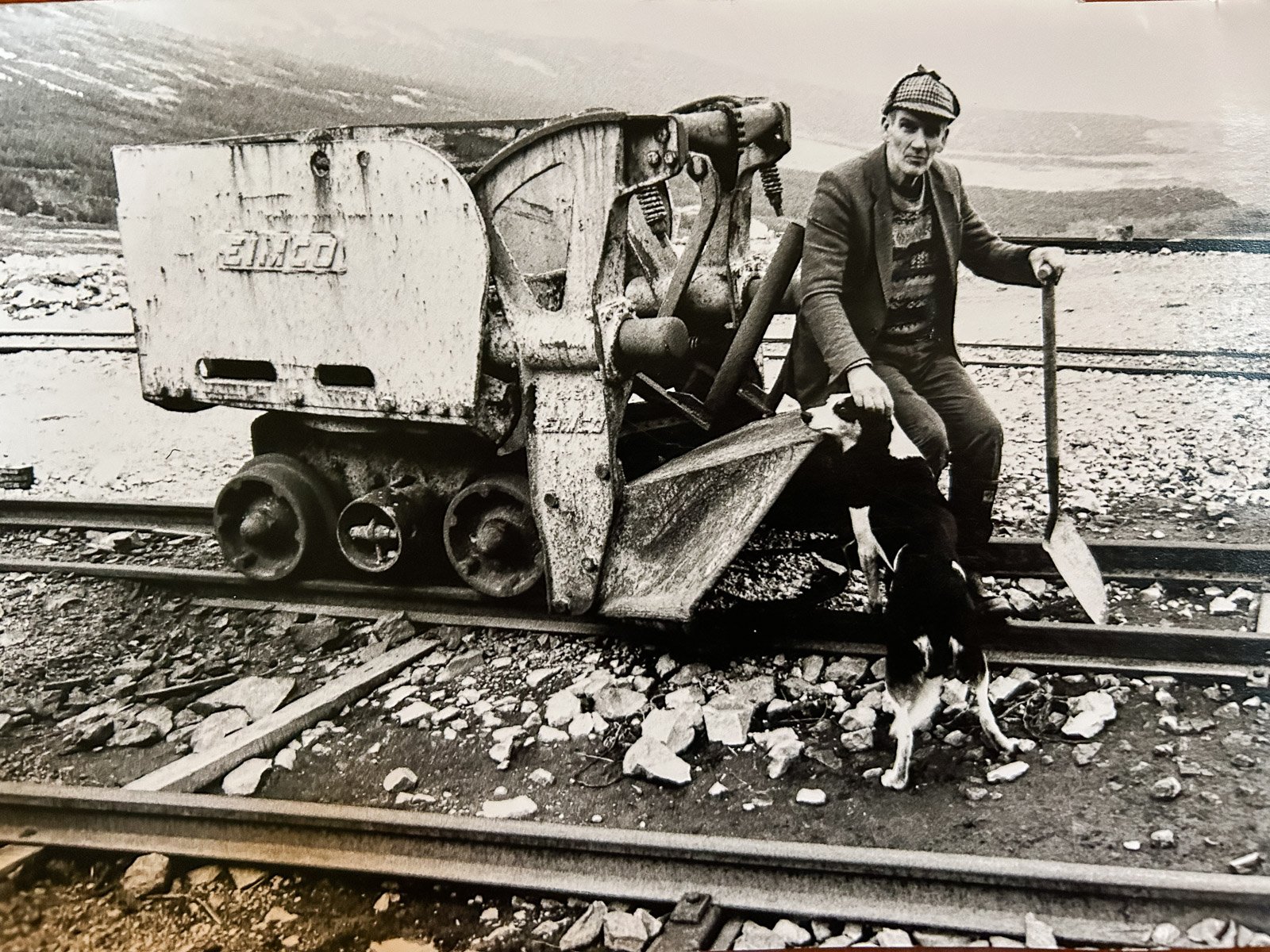
John Burton on mine tracks at Cononish (John Burton)
Gold in the ground
John Burton farmed at Cononish, three miles up a track above Tyndrum, for most of his working life. He knew there was gold in the streams. Most people did. He did not expect anyone to come knocking at his door about it.
In 1983, two men arrived at the farmhouse asking if they could do preparatory work, looking for minerals on his land. It was only later that it became clear they were looking for gold.
-
in 1983, uh, two gentlemen came to the farmhouse door wondering if it was possible to do a preparatory work for looking for minerals on the on my land, if that was possible. So I said yes. I never gave it much thought. And eventually, after a little probing, we found out it was gold they were looking for.
And there was, uh, a drilling company came in in 1985, I think, uh, to drill, and they put down 10 drill holes. Three were very successful. Two were a bit marginal. The rest were absolutely nothing. So, they weren’t too sure whether that was good enough or not. But they thought the next year they would give it a trial. And the first four drill holes they put down, you know, they hit the proper vein on each one, so that counteracted it.
Then they put in a, an adit about I think it’s about, uh, 800 meters into the hillside, and they put that in along the, the vein. So they excavated, you know, a lot of material. So they at least knew that there was a possibility of the mine after that, and they eventually got planning permission.
Uh, the company had it probably didn’t have enough money to develop it, so they sold it on to another company. And that was a Canadian company. And they, unfortunately, I think they were actually a very good company, but the price of gold plummeted, and with the expenditure they put into it, they went bust. Uh, so it more or less stood that way till about 2007.
And then there was a company called Scotgold came in, and they developed the mine, and they took quite a, uh, quite a number of, uh, loads of gold concentrate and sent it off to Malaysia. And they seemed to be doing pretty well, but unfortunately, the, the things didn’t go too well for them, and they ran out of money, and they went into, uh, not receivership. Well, liquidation. It’ll not really matter, but they were more or less bust anyway.
So we’ve now got a new South African company mining, a private company, no, uh, nobody with shares or anything like that. There’s, I think there’s three gentlemen in South Africans have their money in it, and they seem to be making a really good job just now in the last couple of months or so. They’ve sold a lot of gold concentrate. So with the price of gold, they seem to be doing very well.
Uh, now, you may begin to think, “Gosh, that man must be wealthy.” But in actual fact, uh, I don’t own the gold, but I do have, uh, a little bit of power over them because they need access rights to get into my farms. So that’s how it goes. So everything’s pretty jolly on the farm just now.
-
I did actually know that there was traces of gold in the gravel in the river, but I never thought, you know, that anything would ever come of it because, you know, most of the streams round about here have a little bit of gold in them, and people do go panning for gold. But I guess we were pretty lucky that a struck-out spot in my time. I don’t know that I’ll see it out or not, but it’ll be there for somebody.
A gold mine of headlines
Stories of a gold rush at Tyndrum have appeared in local and national newspapers for nearly forty years. John Burton collected cuttings over many years and kindly made them available to Stories of the Land. They allow us to follow the changing fortunes of the Cononish mine, from the excitement surrounding the first explorations to the long struggle to make commercial mining a reality.
April 1985 — “I’ve Got a Gold Mine!” — Sunday Mail
Farmer John Burton was photographed panning for gold outside his cottage after prospectors identified a gold-bearing seam on his farm. Although the newspaper imagined the possibility of sudden riches, John remained cautious, saying that he intended to continue farming while he waited to see what happened. →Read the Article
April 1986 — “The Forty Miners of ’86” — The Glasgow Herald
Exploration geologists and students were depicted as modern-day prospectors searching the Scottish hills. The article placed Cononish within a much wider resurgence of interest in Scottish gold, driven by modern surveying and drilling techniques rather than traditional panning. →Read the Article
September 1987 — “Gold in Them Thar Scottish Hills” — The Observer
After several years of exploration above Tyndrum, geologists reported substantial veins of high-grade gold-bearing rock. John Burton described finding tiny flecks of gold in the burns as a boy, while reflecting on what a commercial mine might mean for his farm and family. →Read the Article
January 1988 — “Is There Gold in Them Thar Hills?” — Stirling Observer
The paper suggested that 1988 might finally be the year in which Scotland gained its first modern gold mine. Exploration was moving towards engineering assessments, although John Burton continued to adopt a characteristically cautious attitude. →Read the Article
1990 — “The Community Sitting on a Gold Mine” — The Glasgow Herald
Tyndrum residents welcomed the prospect of Scotland’s first industrial gold mine and the jobs it might bring to a community heavily dependent on passing tourists. Environmental organisations, however, raised concerns about the effects of mining within the surrounding landscape. →Read the Article
July 1996 — “Golden Aye for Mine’s Future” — The Herald
With surveys indicating rich deposits, another consortium announced that it was ready to begin operations. The report described work inside the existing tunnel and renewed expectations of employment during construction and mining. →Read the Article
July 2000 — “There’s Gold in Them There” — The Daily Telegraph
The proposed sale of the Cononish estate attracted attention because it included the land around Britain’s only prospective gold mine. The estate was marketed as a farm, sporting property and potential source of mineral wealth, with the underground reserves then valued at tens of millions of pounds. →Read the Article
November 2006 — “A Golden Opportunity” — Daily Mail
A steep rise in the price of gold revived hopes of reopening the tunnel. The report emphasised possible jobs, increased tourism and the special appeal of jewellery made from traceable Scottish gold, while acknowledging the practical and environmental difficulties of extracting it. →Read the Article
February 2007 — “There Ain’t No Gold in Them Hills” — Daily Record
Only months after renewed optimism, the mine was reported to be closing after nearly two decades of failure. Photographs of rusting wagons and abandoned equipment presented Cononish as a dream that had repeatedly failed to deliver. →Read the Article
May 2007 — “Gold Rush in Prospect as Plan Unveiled for Highland Mine” — The Scotsman
A new plan quickly revived the project. The newspaper reported that approximately £70 million of precious metals might lie beneath the hills and looked back to Tyndrum’s earlier, short-lived mining boom. →Read the Article
September 2008 — “Prospect of £80m as Gold Rush Is Underway” — Daily Mail
Exploratory drilling began again under Scotgold Resources. The company hoped to confirm the size of the deposit, secure planning permission and create around sixty jobs, although commercial production was still thought to be at least two years away. →Read the Article
August 2010 — “Planning Chief Backing Scotgold’s New Application for Tyndrum Mine” — The Scotsman
After an earlier proposal was rejected, Scotgold returned with a revised design. The company forecast gold and silver production, 52 full-time jobs and a small quantity of specially assayed “Scottish gold” for jewellers and goldsmiths. →Read the Article
September 2010 — “Village Fury over Gold Mine Decision” — Stirling Observer
The National Park’s refusal of planning permission provoked anger among supporters in Tyndrum. Community council chairman John Riley argued that decision-makers had given insufficient weight to employment and the survival of small rural businesses, while supporters of refusal emphasised environmental protection. →Read the Article
April 2011 — “Gold Mine Appeal Pulled as Scotgold Gears Up for Fresh Bid” — The Scotsman
Scotgold withdrew its appeal and prepared another planning application. Revised proposals sought to address concerns about the tailings facility, landscape and visual impact, demonstrating how the mine’s design was shaped by its location within the National Park. →Read the Article
March 2021 — “Argyll Is Pure Gold to Television Producers” — The Oban Times
With commercial mining finally beginning, the Cononish story became the subject of the BBC television series Gold Town. The programme featured John Burton and his family, the local mining team and businesses in and around Tyndrum. →Read the Article
March 2021 — “Our Golden Harvest” — Daily Mail
Thirty-five years after the first newspaper reports, John Burton saw the mine enter production. His son Davy and grandson Conor were now working there, making the venture a three-generation family story. Davy had even had wedding rings made from gold produced during an earlier trial pour—a particularly personal connection between the family and the land. →Read the Article
November 2023 — “There’s Not Enough Gold in Them Thar Hills!” — Daily Mail
The collection ends with another sharp reversal. After decades of optimistic estimates, the mine was struggling to produce enough gold, and its operator faced serious financial difficulties. For the Burton family, the rental income had been useful rather than life-changing; for investors and the local workforce, the mine’s uncertain future brought renewed disappointment. →Read the Article
Across almost four decades, the language of a “gold rush” returned again and again. Each new survey, company, planning application or rise in the price of gold generated fresh predictions of prosperity. Behind those headlines were people living with the consequences: a farming family waiting to learn what lay beneath its land, miners hoping for secure work, a village seeking a more resilient economy, and others asking what industrial extraction would mean for the surrounding landscape.
A contentious planning decision
John describes one of the key moments in the story of gold at Tyndrum, when Scotgold Resources eventually applied for planning permission to mine at Cononish; it was to prove contentious, especially with the newly created National Park.
-
It was very contentious. In fact, the Park’s board, uh, voted it down, uh, the first time they sought planning permission. But there was quite a strength of feeling, and I think it possibly came from government. You know, “This looks too good to be true. Reverse your decision.” And the next year, the Parks gave a unanimous decision to pass it. So that was good, very good as far as I was concerned anyhow.
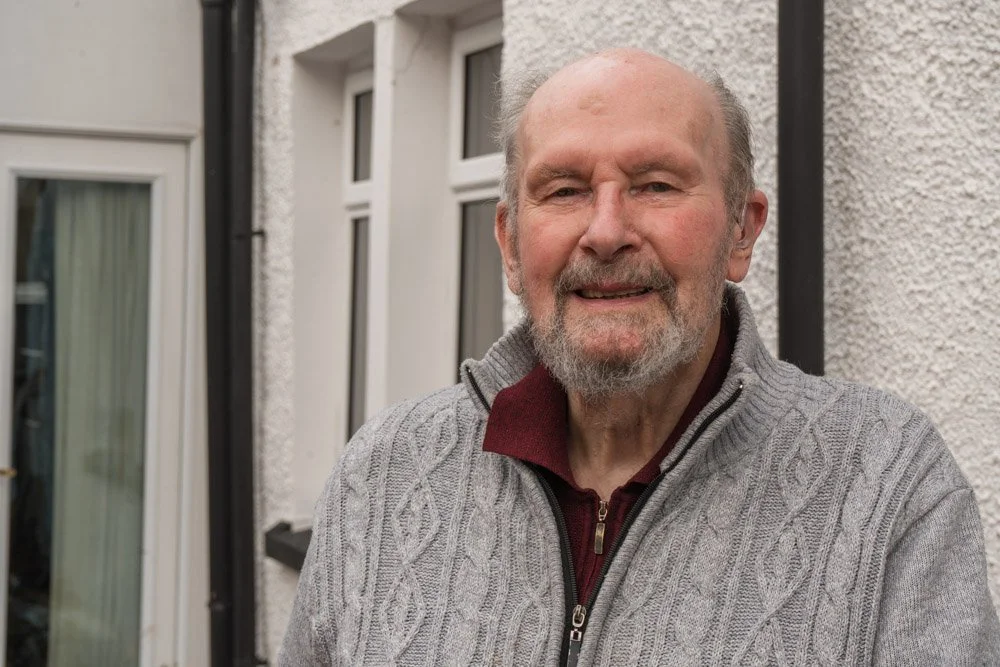
John Riley
John Riley came to Tyndrum with his wife, Barbara, in June 1982, leaving behind a career in the metals industry to take over the Invervey Hotel. They ran the hotel until 2001, later joining former members of staff to buy the Rod and Reel pub in Crianlarich. A passionate advocate for strong, self-determining communities, John also served as Chairman of both Strathfillan Community Council and the Strathfillan Community Development Trust, helping to advance housing and a wide range of community projects across the area.
John Riley, chair of the community development trust, had watched several mining companies come and go over the years, each promising community benefit and each eventually fizzling out, Richard Gray from ScotGold met with the community to explain the benefits they would receive.
John describes the planning battle and what it meant when permission was finally granted. He starts by talking about John Burton, whose farm the gold would be mined on.
-
He was born here, and he'd been hearing about gold for a long time. And my God, he was like a young-looking man in some of the pictures from the—but anyway, we're good friends.
And, you know, I can't remember. There were several different firms that came along who were going to do it, and spoilers a tale about community gain, this sort of thing. And they sort of all fell apart. I can't find gold was one of them.
And we met all the directors and everything else, and it just fizzled out. Then Caledonia Mining, he was going around getting spoil heats from gold mines and using much better metallurgical extraction techniques than they'd had when they did the mines to extract the gold out of the tailings, sort of thing. But he fizzled out as well.
Then Chris Sangster came along with Scotgold, and we had a high regard for Chris and the people who worked with him, the geologists and everything else. But at some stage, they demoted him to executive director rather than managing director, and he was pushed to the side.
And the guy who took over, but he was very good, and they explained to the community in meetings of all kinds of things what was happening.
They were going to make a fortune, and the community would get half a million quid. And for me, that was wonderful because I'm a great believer in community and worldwide, actually. The new owners—Scotgold went into liquidation. The new owners, Acrocs, came to see the community, and I was introduced as the guy who battled for the gold mine with the planners. And I got chatting to them. I said, "Scotgold are going to give us half a million quid." And the guy said, "Well, that's ridiculous.
-
It was a difficult time. The community felt very, very strongly about it.
I mean it was going to provide employment; it was going to provide all kinds of advantages for the community and is doing actually.
They decided to turn it down on environmental grounds and eventually Scotgold changed the plan and the settling ponds, more of them and they could be blended into the background and disappear in effect in the long term once the mining was finished.
But now mining is taking place, we're not aware of any settling ponds at all.
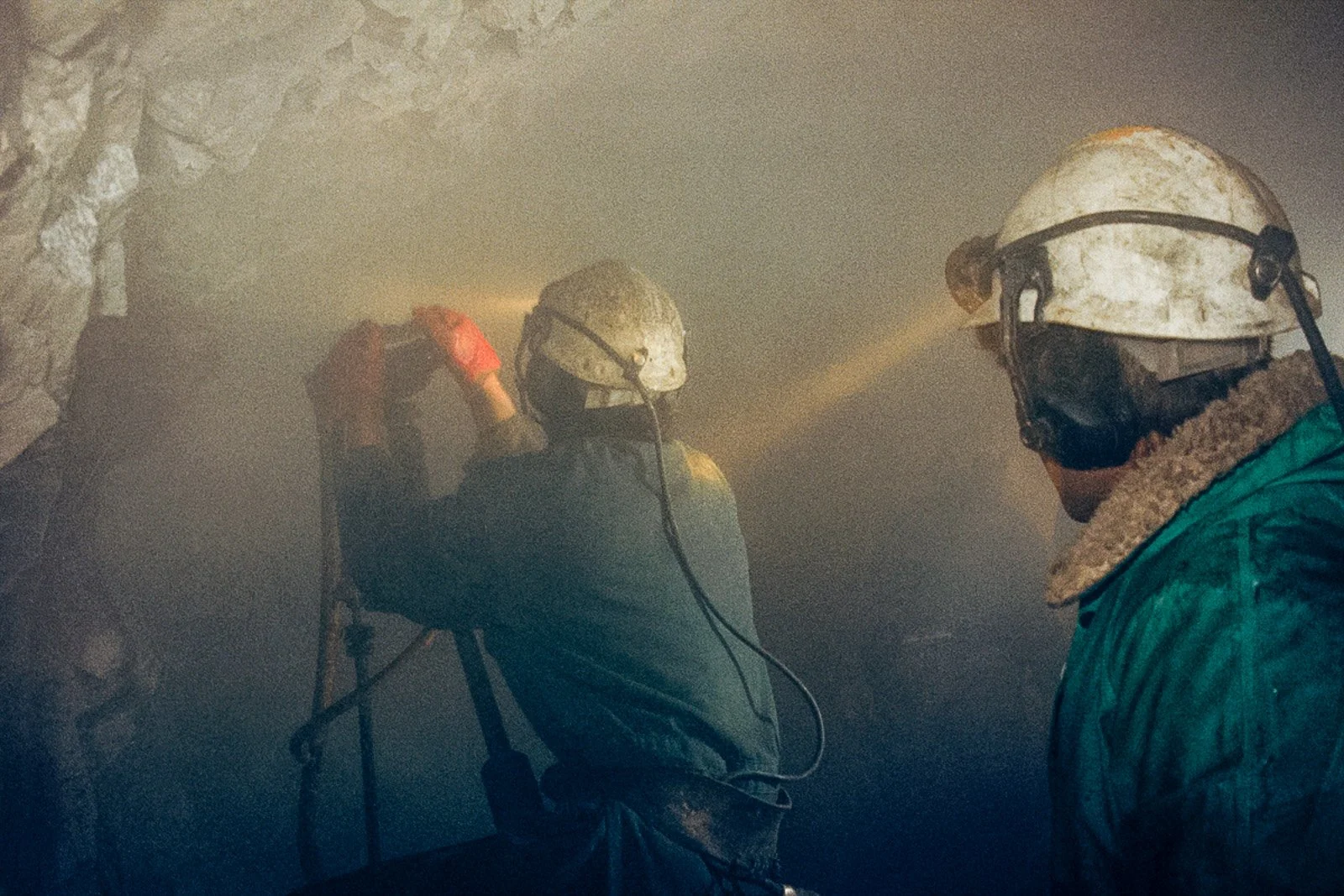
Miners at Tyndrum Gold Mine
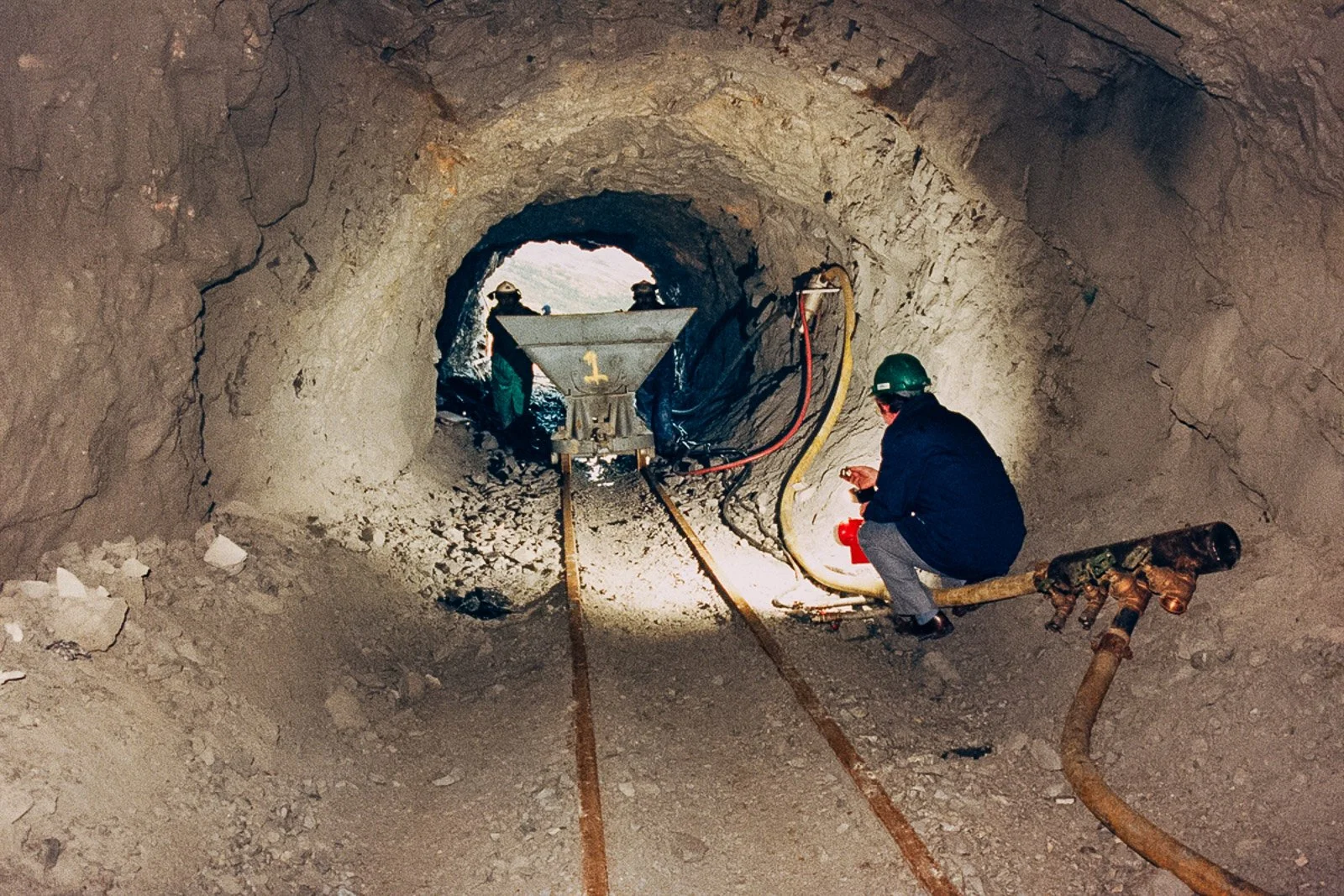
(Both pictures Historic Environment Scotland)
What the mine means
The mine at Cononish is now operating. For John Riley, the employment it has brought to the area is the central fact, and the community growth that has come with it.
-
Well it's wonderful. I mean the Acrux are employing 60 people.
Some local, well the community is growing you know. Some have come from far away, some live here and in effect the workers are living in chalets in different businesses who've got chalets like the Ben Moor has got a number of chalets and they're taking up all those chalets. And it's much better than living in the Royal Hotel.
At one stage there was 50 miners living in the Royal Hotel. I imagine it needs a total refurbishment. You can imagine the mess.
John Burton, on whose land the mine sits, takes a similar view. The mining company has honoured its financial commitments to the community, and the jobs it has created reach across several villages.
-
Yes. The mining company have a commitment to the local community to pay them an annual fee, which I think the second one of the companies that was there, you know, they couldn’t meet that commitment. But as far as I understand, this company has been very good and has made all the commitments to the community. So at least the community are getting some money out of it. The other thing, of course, is there’s 100 people employed off and on, plus contractors and, you know, garages, what have you, involved in getting some advantage out of the mine. So not all of those 100 people, of course, are actually local, but there’s quite a number of locals from Killin, Crianlarich, Tyndrum, I think, even Dalmally. So it must be good for the district, hopefully.
Not everyone sees it that way. Sarah Heward, who runs the Real Food Café in Tyndrum, questions whether the community has genuinely benefited and what the costs have been.
-
Personally, I don’t think the gold mine has been a benefit to the community or the environment, and I’m pretty shocked the National Park allowed it to be honest. The community hasn’t really benefited at all. In fact, it has put more pressure on the already limited housing there is here.
Gold in the burns
Rena Baillie ran Strathfillan Wigwams for thirty years and welcomed visitors who returned regularly to pan for gold.
Some showed her carefully labelled finds, recording where the gold had been found and how much it weighed. Others had jewellery made from it. Rena remembers one visitor who returned to find more gold whenever a new grandchild was born.
-
We used to get a lot of regular gold panners, this man, he always came in a camper van. The day he was leaving, he came back with this little box, and he opened it up, and it was full of all the gold that he's found, and he had it all marked where he found it, and the weight of it, and I had other ones that had made jewellery from the gold that they'd found.
And one man was making it for all his grandchildren, so every time there was a new grandchild, he had to get more gold. It's quite something.
And they do gold panning competitions. Oh right, I know, but it's not from the gold that they find in the river, they put gold in water troughs, and they get so long to find it or something. It's quite unique.
Living alongside mining
Fiona remembers childhood visits to abandoned workings. John Burton recalls the first approach from prospectors, while John Riley and Sarah Heward describe different views of the commercial mine.
Alongside the survey and newspaper cuttings, these memories record what mining has meant to people living nearby: work, income, uncertainty and changes to familiar places.
Thank you to everyone who shared their stories about mining in Crianlarich, Tyndrum and Killin.