
Steamers on Loch Tay
For more than half a century, steamers carried residents, visitors and goods between communities around Loch Tay. From 1886, passengers could connect with the railway at Killin Pier, continuing through Killin village to Killin Junction and the wider rail network.
Travelling across the loch
The Loch Tay Steamboat Company was established in 1882 by Gavin Campbell, Earl of Breadalbane. Its vessels connected Killin and Kenmore, calling at piers serving communities around the loch.
The principal passenger steamers were Lady of the Lake and, from 1907, Queen of the Lake. Smaller vessels carried goods and supplies. For residents, the boats provided transport between lochside settlements; for visitors, they offered a way to explore Loch Tay from the water.
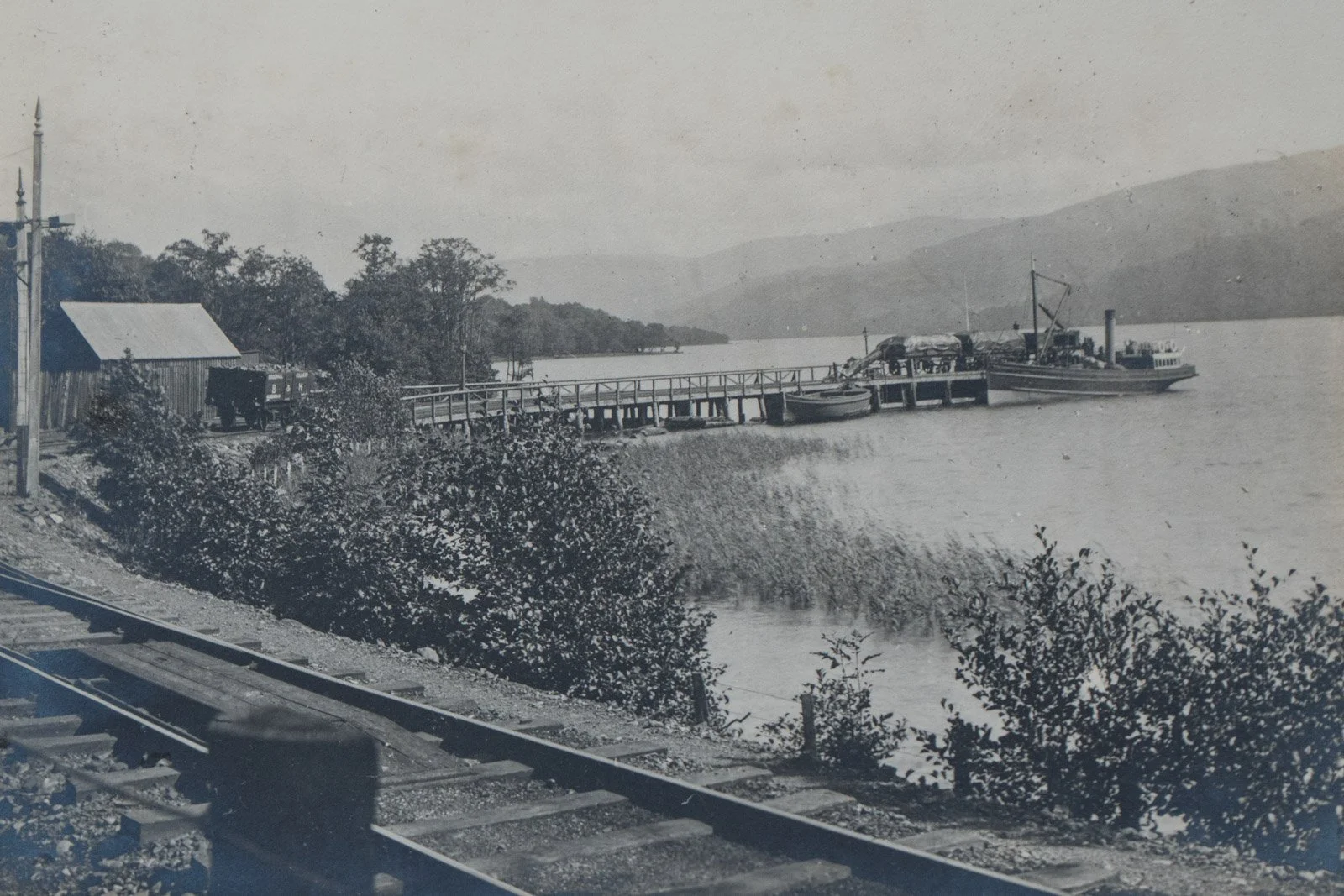
Loch Tay Pier, Killin
Connecting with the railway
The Callander and Oban Railway initially served Killin from a station several miles away, later renamed Glenoglehead. The opening of the Killin branch in April 1886 brought trains into the village and onward to Loch Tay station beside the steamer pier.
Passengers arriving by boat could board a train for Killin Junction, where they changed for services on the Callander and Oban line. Travellers arriving by rail could continue along the loch to Kenmore and other stopping places.
Railway companies promoted excursions combining trains, steamers and road journeys. These connections helped bring visitors to Killin and the surrounding district.
Queen of the Lake
Built by Ailsa Shipbuilding, Queen of the Lake was transported in sections and assembled beside Loch Tay in 1907. She carried passengers on scheduled sailings and summer cruises.
As other vessels were withdrawn, Queen of the Lake continued the service. She became the last of the loch’s regular passenger steamers, operating until the outbreak of the Second World War in 1939.
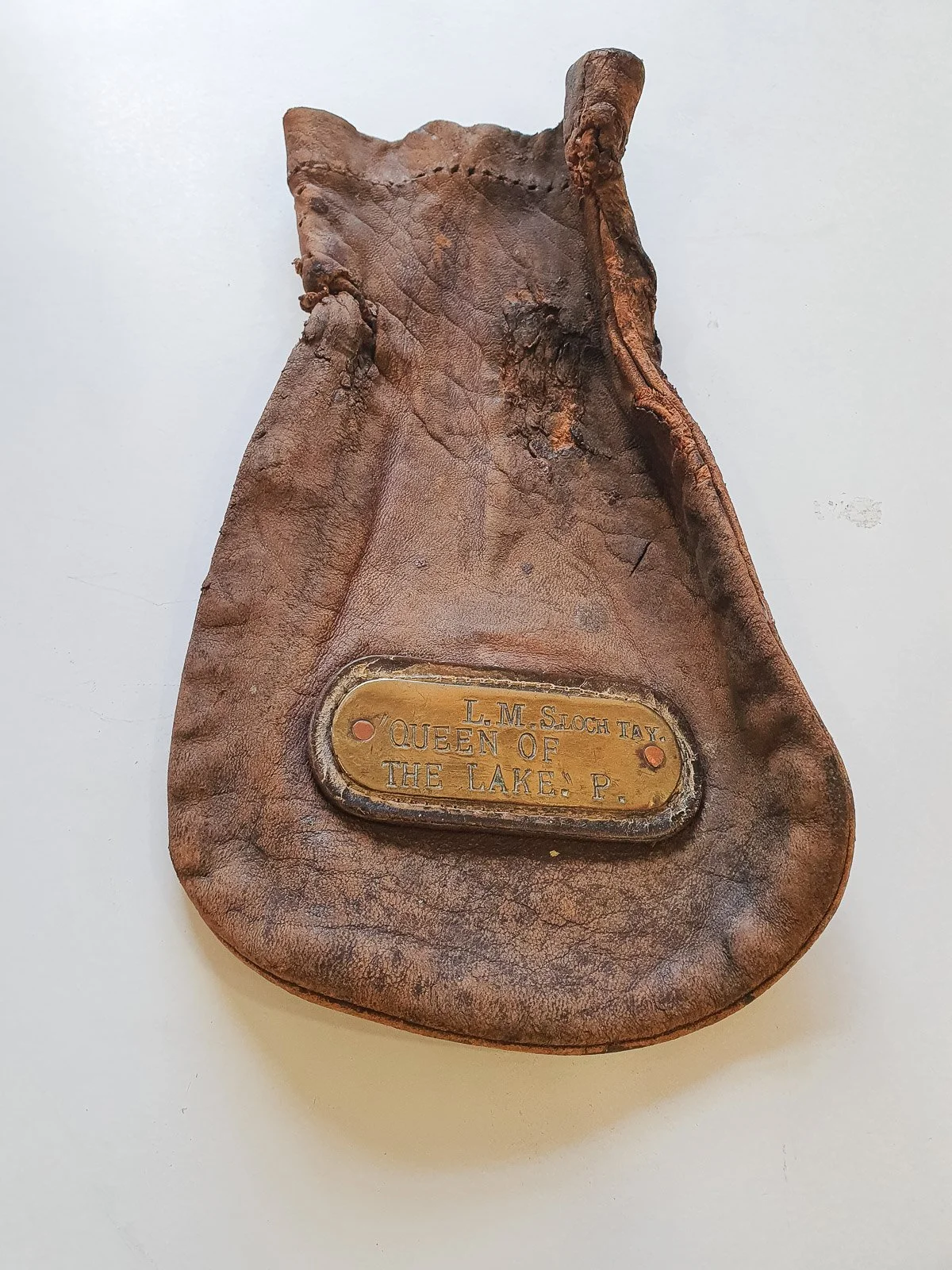
Collecting the fares
A worn leather money pouch displayed at the Old Mill in Killin offers a tangible link to life aboard Queen of the Lake. It was used to collect fares from passengers travelling on the steamer between Killin and Kenmore.
A brass identification plate sewn onto the pouch is inscribed:
L.M.S. LOCH TAY
QUEEN OF THE LAKE. P.
The initials “L.M.S.” refer to the London, Midland and Scottish Railway, which took control of the railway and associated steamer services in 1923. This indicates that the pouch was used during the final period of Queen of the Lake’s working life, between 1923 and the withdrawal of the Loch Tay steamers in 1939.
Its broad opening made it practical for collecting coins as the crew member moved among the passengers, while the thick leather was strong enough to withstand years of regular handling. Its creases, repairs and worn surface reflect a working object used on countless journeys across the loch.
As one of only two principal passenger steamers to operate between Killin and Kenmore, Queen of the Lake carried local people as well as the growing number of tourists arriving by rail.
The end of the service
Road transport gradually took over work previously carried by the steamers. The carriage of mail transferred to motor vehicles in 1911, and services were reduced during the First World War.
By the end of the 1920s, Queen of the Lake was the remaining passenger steamer. When services stopped in September 1939, she was hauled onto the slipway at Kenmore. She never returned to the water and was broken up there in 1950.
Passenger services to Loch Tay station also ended in September 1939, although trains continued to serve Killin village. Parts of the branch remained in use for goods traffic, including materials for hydroelectric construction.
The Glen Ogle landslide brought railway services to an end in September 1965, ahead of the planned formal closure on 1 November.
Timeline
June 1870: Railway reaches the original Killin station
The Callander and Oban Railway opens to the station later renamed Glenoglehead, several miles from Killin village.
August 1873: Railway reaches Tyndrum
The line extends west through Glen Dochart and Crianlarich to Tyndrum.
1882: Loch Tay Steamboat Company established
The Earl of Breadalbane establishes the company to operate services on the loch.
1 April 1886: Killin branch opens to passengers
Trains connect Killin Junction, Killin village and Loch Tay station beside the steamer pier.
1907: Queen of the Lake enters service
The new passenger steamer joins the Loch Tay fleet.
1911: Mail transfers to road transport
Motor vehicles take over the carriage of mail previously handled by the steamers.
1922: Caledonian Steam Packet Company takes over
The company takes responsibility for the Loch Tay steamer service.
1923: Railway grouping
The Killin Railway becomes part of the London, Midland and Scottish Railway.
1929: Older vessels withdrawn
Lady of the Lake and Sybilla are broken up at Kenmore. Queen of the Lake continues operating.
September 1939: Passenger services end
Steamer sailings and passenger trains to Loch Tay station cease at the outbreak of war.
1950: Queen of the Lake broken up
The vessel is dismantled at Kenmore after spending the war and post-war years on the slipway.
November 1964: Killin branch freight services end
Regular goods traffic on the branch ceases.
September 1965: Landslide interrupts rail services
The Glen Ogle landslide brings services through the glen and on the Killin branch to an early end.
1 November 1965: Formal railway closure
The scheduled closure takes effect.